This is the website of the NZ Social Credit Association
the educational arm of Social Credit in New Zealand
The Social Credit Party stands candidates for elections to parliament and it's economic policy aligns with ours. It has a wide range of policies covering most aspects of life in New Zealand.
"New Zealand should use its own bank
to fund the Covid-19 rescue package"
Help us fund this petition and support our campaign
to get the government to use the Reserve Bank.
Click "Donate" at the top of the page.
Experts call for Government to 'direct fund' the economic
rescue package from the Reserve Bank at no cost to taxpayers
If
this government is serious – and it should be - about supporting
economic activity and avoiding deflation by a massive fiscal spending
package, financing its package by issuing money in the current
circumstances has impeccable support from mainstream economic thinking.
More importantly, in the current context it is the correct, most
efficacious way to proceed. The current government should not continue
to be prisoners of outmoded, arch-conservative political doctrines.
Dr
Geoff Bertram - Senior Associate in the Institute for Governance and
Policy Studies at Victoria University, former Senior Lecturer in
Economics in the School of Economics and Finance at Victoria University.
What the Reserve Bank needs to do now is to make clear
that it can and will purchase government bonds directly from the
Treasury at 0%. These funds should be used to fund the current and
forthcoming economic support packages. This new money must go directly
into the economy, and not slosh about the banking system.
Raf Manji is a former investment banker, and former chairman of the Christchurch City Council finance committee.

The government can borrow from the Reserve Bank. To be
technical it's literally borrowing from itself. We just should not
close off any [options] just because somebody told us 30 years ago that
it was bad.
Ganesh Nana - Senior Economist and Research Director of BERL
I don’t see why we don’t jump straight to the RBNZ buying bonds from Treasury direct.
"It’s a question of how long do you wait until you get
there,” he said, noting that as governments around the world issue
bonds to pay for COVID-19, central banks will have to step in and buy
these bonds.
Shamubeel Eaqub, economist at Sense Partners, author, media commentator.

“There is an alternatve to a strategy based on higher taxes and/or more government debt - namely, direct, unrepayable funding by the central bank. A transfer from the central bank to the government”
Jordi Galí - Macroeconomist, Research Professor Barcelona School of Economics

There's
no reason why you don't get the Reserve Bank to effectively print the
money and lend it to the government, just as the Reserve Bank did in
1935, when it lent money to the government to build state houses.
Bernard Hickey is Newsroom Pro managing editor and a financial journalist







Social Credit is not Funny Money !
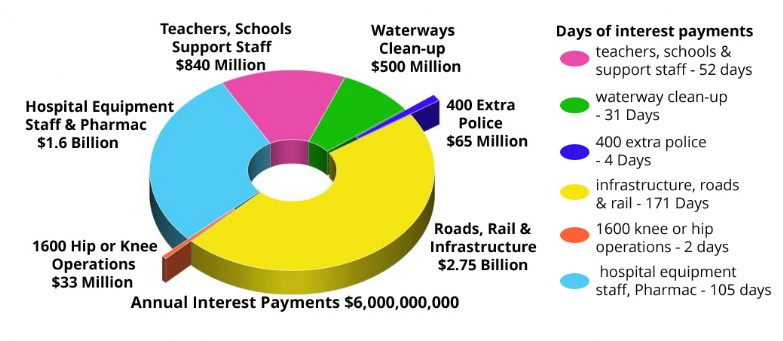
"Funny Money" is a term that would best describe the stupidity of our government and councils borrowing the money they need from overseas owned private financial institutions when they could access it from the country's central bank (the Reserve Bank), which the Government owns.Currently $5,000,000,000 of taxpayer money every year goes to pay interest when it could go towards things that benefit Kiwis - like better health care, housing the homeless, fixing child poverty, better education, building houses, roads, and sewage plants, fully funding St Johns Ambulance, etc.
Locally, economists like Dr Geoff Bertram, Ganesh Nana, Raf Manji, Shamubeel Equab, and Jordi Gali and commentators like Bernard Hickey, and Bryan Gould are recommending that approach to help the country through the current Covid 19 crisis, and internationally that approach is being recommended.
Social Credit is committed to changing that, and putting in place a financial system that really works for New Zealanders and the planet.
Here's what could be done with that $5 Billion every year
LATEST
Ideological purity costing taxpayer billions
Over the coming decades taxpayers will spent billions of dollars paying off the government’s economic rescue package because the Reserve Bank and the Government don’t want to ”blur the lines between fiscal and monetary policy” according to RBNZ’s assistant governor, Christian Hawkesby.
That means funding of the rescue package will be done through an economic merry-go-round that will see a massive transfer of wealth from citizens to the mainly overseas shareholders of the country’s banks and investment funds.
The result will be kiwis saddled with massive additional debt and interest payments when it could have cost nothing – freeing up tax dollars to be spent on health, education, housing and infrastructure.
The Reserve Bank could directly fund the $52 billion package without incurring any cost to taxpayers – something called for in recent days by former Senior Lecturer at the School of Economics
That call has been echoed by economists Raf Manji and Shamubeel Eaqub and economics commentators Bernard Hickey and Bryan Gould .
“This is not wild radicalism. It is mainstream, even conservative, economics,” according to Dr Bertram.
The Bank of England has just announced it will directly fund some of the British Government’s rescue package and there’s no bar on our Reserve Bank doing the same.
Instead the government is borrowing that $52 billion dollars through the sale of bonds to banks and other financial entities and investors. Those purchasers buying the newly issued government bonds are the very same people who are now flush with funds because the Reserve Bank is spending $30 billion dollars to buy from them bonds they previously held.
Those wealthy investors will make a substantial profit from ‘clipping the ticket’ on both transactions, and taxpayers will foot the bill.
$5 billion dollars of taxpayers money already goes every year to pay interest on existing government debt – money that could be spent on health services, solving the housing crisis by building rent to own homes, providing free dental care, or a multitude of other possibilities.
Finance Minister Grant Robertson wants to add even more to that figure. “New Zealand
The self imposed appearance of the Reserve Bank not directly financing the Government is sheer economic madness in these unprecedented times.
Bernard Hickey recommends using Social Credit economic policy
In May last year Treasury suggested the government and the Reserve Bank might have to consider ‘unconventional tools’ like Quantitative Easing and helicopter money, both of which are similar to Social Credit economic ideas.
The Reserve Bank this week announced that it was preparing to undertake QE, and today on National Radio, economic commentator and Newsroom Pro editor Bernard Hickey claimed the government needed to introduce a modified version of helicopter money – using the Reserve Bank to fund a Universal Basic Income, similar to National Superannuation, for all citizens.
Social Credit terms its concept a national dividend - under normal circumstances a payment to every citizen to replace income lost by the advancement of computerised workplaces and artificial intelligence (driverless taxis, robots as carers, automated factories).
Under today’s extreme circumstances it could be used, as Bernard Hickey recommends, as a short term measure to replace income lost through job losses, workplace closures, and business failures, ensuring that people have money to put food on the table, pay their bills, and keep the economy ticking over, to avert an even worse economic collapse.
The European Central Bank has just announced it will be doing $150 billion Euros of QE immediately, buying government bonds from banks and pension funds.
Our Reserve Bank could go one step further and purchase newly issued government bonds directly, rather than existing bonds from banks, to provide the government with a source of debt-free, zero-interest money at no cost to taxpayers to fund a basic income as part of the economic rescue package.
Using that method, taxpayers will not have to pick up the long term tab for billions in interest payments and the repayment of the debt which under standard QE simply provides bigger profits for the overseas shareholders of banks and other financial institutions.
Central banks buying government bonds directly is a common occurrence in Canada Japan China
The Commonwealth Bank (Australia
The first Labour government financed the building of thousands of state houses with Reserve Bank money.
Social Credit’s economic policies are now in demand, and we’re ready to assist the government in its efforts to help New Zealanders through the current crisis and to build a better long term future for Kiwis.
Reserve Bank increasing kiwis debts & bank profits
Recent actions by the Reserve Bank and the Government will facilitate a massive transfer of wealth from citizens to the country’s banks, increasing bank profits beyond $6 billion this year.
Meanwhile kiwis are being saddled with massive additional debt and interest payments.The Bank is buying Government Bonds (public debt) from banks and swapping it for cash – so that the banks can on-lend.
Reserve Bank governor Adrian Orr's comment that the bank would consider ‘unconventional tools’ like buying government bonds, would come as a shock to the governors of the central banks in Canada, Japan and China.
Finance Ministers in those countries have accessed funding from their central banks at zero interest for years.
The Bank of Japan has purchased approximately 50 per cent of government issued bonds, and the Chinese central bank has funded the bulk of China
If the NZ government financed its borrowing through the Reserve Bank it could save taxpayers $5 billion every year - money saved on interest payments on the borrowing it does from commercial banks and other financial institutions.
That $5 billion could then be spent on health services, solving the housing crisis by building rent to own homes, providing free dental care, or a multitude of other possibilities.
Currently government is effectively taking $5 billion off taxpayers every year and giving it to overseas bank shareholders and investors.
Central banks buying government bonds used to be a common occurrence. The first Labour government financed the building of thousands of state houses with Reserve Bank money.
The Commonwealth Bank (Australia
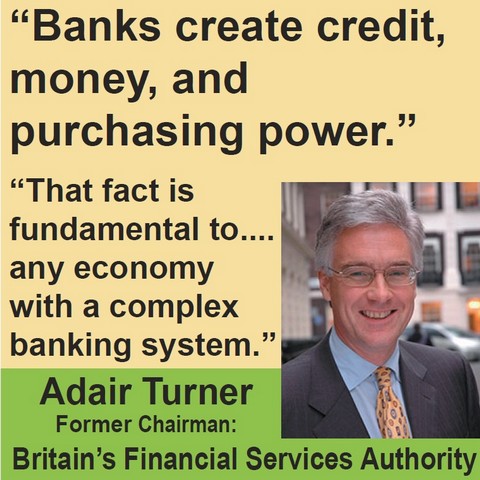
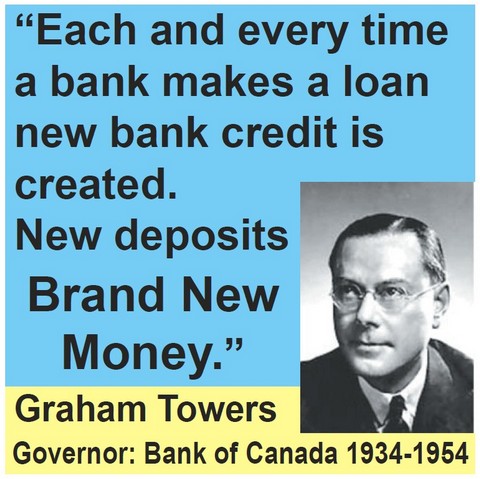
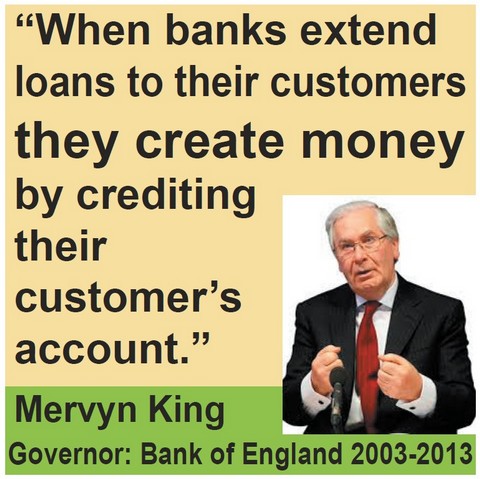
Commercial banks create money every time they grant a loan – to individuals to buy houses, to businesses, or to the government.
This has been confirmed by leading figures in the banking industry like Mervyn King, former governor of the Bank of England, and Graham Towers Bryan Gould .
The country’s central bank, the Reserve Bank, also has that power, so if it’s good enough for Canada Japan China